Database of Disordered Zeolite Structures
 
Intergrowth Family IM-18
2-dimensional disorder of the units connecting ordered layers
Periodic Building Unit
 
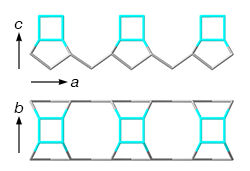
  Periodic Building Unit (PerBU): Layer of isolated zig-zag chains  
  Layer symmetry p m m 2  
  2D cell parameters a = 10.48 Å b = 7.55 Å gamma = 90°    
  Comment To facilitate understanding of the connectivity patterns shown below, O atoms that connect to a single row of d4r units have been highlighted in the layer of isolated zig-zag chains shown to the right.
 
 
Connecting unit
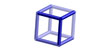
  Connecting unit d4r    
 
References
 
    Cichocka, M.O., Lorgouilloux, Y., Smeets, S., Su, J., Wan, W., Caullet, P., Bats, N., McCusker, L.B., Paillaud, J.L. and Zou, X.D.
   "Multidimensional disorder in zeolite IM-18 revealed by combining transmission electron microscopy and X-ray powder diffraction analyses"
   Crystal Growth Des., 18, 2441-2451 (2018)

Connectivity pattern

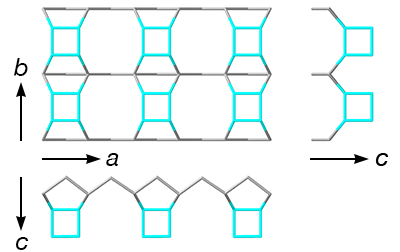
Each layer of zig-zag chains is generated from the previous one by a mirror plane (or a shift of 1/4a). The zig-zag layers themselves are fully ordered in 3 dimensions. However, the rows of d4r unit connectors can be disordered along both b and c, making the disorder in this family 2-dimensional.

Examples

Positions of d4r unit connectors in a row
There are two possible positions for a row of d4r units above two neighboring zig-zag chains in the layer. The position of the first d4r unit (along a) determines the positions of all the other d4r units in that row.

 
Symmetry
Operations
Translation Comment Image
0
  d4r units in position 1
1/2a
  d4r units in position 2
Examples

Disorder along b: layers formed by the rows d4r unit connectors
The arrangement of the rows of d4r units is not necessarily periodic along b. Each row can be the same as the neighboring one or shifted by 1/2a.


First row Next row Comment Image
position 1
position 1
  shift of 0a*
position 1
position 2
  shift of 1/2a*
* relative to the previous row of connectors
Examples

Disorder along c: stacking of the layers of connectors
The d4r units in the connecting layers can also be disordered along c. The ordered zig-zag chains are shifted by 1/4a in adjacent layers. The rows of d4r unit connectors can be stacked along the [001] direction using either of the following connectivity patterns.

 
First layer Second layer Comment Image
position 1
position 1
  shift of 1/4a*
position 1
position 2
  shift of 1/4a*
* relative to the previous row of connectors


Effect on channel system
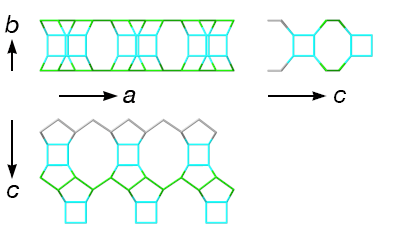
The disorder can block one or both of the straight 10-ring channels (e.g. those present in polymorphs A and B) when both d4r positions are present in a single layer of d4r units (see polymorph C).

Simplest ordered end members
Connectors are shown in light blue.
Adjacent PerBUs generated by the same connectivity pattern (with or without connectors in between) are shown with different shades of the same color for clarity.